 Image 1 of 1
Sandra Rendon | Solve et Coagula
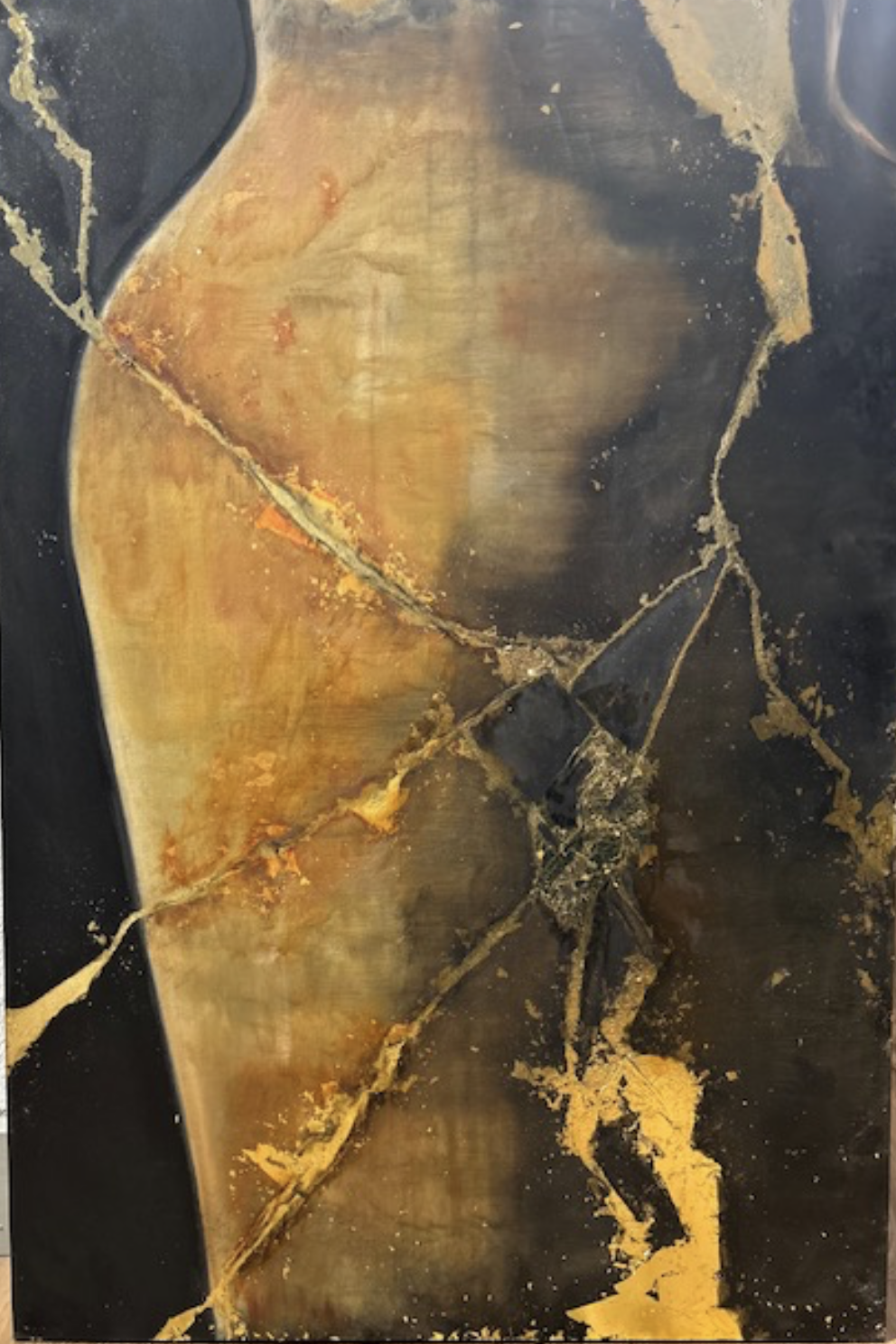
Sandra Rendon, Solve et Coagula, mixed media, 24x36 in.
INSPIRATION
This piece is inspired by kintsugi, the Japanese art of repairing broken ceramics with gold. Rather than concealing fracture, kintsugi honors it, revealing rupture as a site of transformation and renewal.
The work functions as a visual allegory of the alchemical principle Solve et Coagula: to dissolve and to reunite. It reflects the cyclical process of separation, breakdown, and reintegration through which matter and consciousness are refined.
The fractured vessel embodies experiences of loss, rupture, and deconstruction. Its golden seams signify resilience, memory, and transmutation. What was once broken is not erased, but elevated; reconfigured into a form of greater integrity and meaning.
ARTIST STATEMENT
My artistic practice centers on the exploration of anima; the inner life force that animates the human body and connects us to forces beyond the material. Rooted in Renaissance and Classical techniques and informed by academic training, my work bridges figuration and abstraction to examine the emotional, ethical, and spiritual dimensions of human existence in an increasingly fragmented world.
At the core of my practice is a belief in interconnectedness: between body and soul, inner and outer worlds, and humanity and the larger systems we inhabit. Through oil painting, layered surfaces, and symbolic forms, I investigate how human emotion mirrors broader natural and energetic processes. Light and shadow, structure and dissolution, presence and absence become visual metaphors for moral choice, vulnerability, and transformation.
The human figure functions in my work as both subject and vessel; a site where lived experience, memory, and responsibility converge. In parallel, my abstract works represent the inner landscape without the physical body: distilled expressions of emotion, movement, and consciousness. Together, these two visual languages reflect the tension and harmony between material form and intangible essence, suggesting that what occurs internally shapes the external world we collectively inhabit.
My practice is informed by esoteric symbolism and historical visual systems that understand art as a conduit for knowledge, reflection, and ethical awareness. These traditions resonate strongly in the present moment, as contemporary society faces environmental, social, and spiritual disconnection. While my work does not depict nature literally, it engages deeply with ecological thinking by emphasizing interdependence; reminding viewers that human action, emotion, and intention ripple outward, affecting systems far beyond the self.
I seek to create work that fosters empathy and contemplation. By inviting viewers into a slowed, relaxed, attentive mode of seeing, my paintings encourage reflection on shared human vulnerability.. The gestures of the body, the rhythms of abstraction, and the material presence of oil paint become tools for cultivating awareness rather than consumption.
Ultimately, my work engages the audience to be in the present moment, allowing the necessary safe space to process freely suppressed emotions. It asks viewers to honor their journey; their origins and who they have become. Anima is both a mirror and an invitation: to recognize the intimacy of alchemical processes within ourselves and to appreciate the journey by giving conscious presence in the world we share.
Sandra Rendon, Solve et Coagula, mixed media, 24x36 in.
INSPIRATION
This piece is inspired by kintsugi, the Japanese art of repairing broken ceramics with gold. Rather than concealing fracture, kintsugi honors it, revealing rupture as a site of transformation and renewal.
The work functions as a visual allegory of the alchemical principle Solve et Coagula: to dissolve and to reunite. It reflects the cyclical process of separation, breakdown, and reintegration through which matter and consciousness are refined.
The fractured vessel embodies experiences of loss, rupture, and deconstruction. Its golden seams signify resilience, memory, and transmutation. What was once broken is not erased, but elevated; reconfigured into a form of greater integrity and meaning.
ARTIST STATEMENT
My artistic practice centers on the exploration of anima; the inner life force that animates the human body and connects us to forces beyond the material. Rooted in Renaissance and Classical techniques and informed by academic training, my work bridges figuration and abstraction to examine the emotional, ethical, and spiritual dimensions of human existence in an increasingly fragmented world.
At the core of my practice is a belief in interconnectedness: between body and soul, inner and outer worlds, and humanity and the larger systems we inhabit. Through oil painting, layered surfaces, and symbolic forms, I investigate how human emotion mirrors broader natural and energetic processes. Light and shadow, structure and dissolution, presence and absence become visual metaphors for moral choice, vulnerability, and transformation.
The human figure functions in my work as both subject and vessel; a site where lived experience, memory, and responsibility converge. In parallel, my abstract works represent the inner landscape without the physical body: distilled expressions of emotion, movement, and consciousness. Together, these two visual languages reflect the tension and harmony between material form and intangible essence, suggesting that what occurs internally shapes the external world we collectively inhabit.
My practice is informed by esoteric symbolism and historical visual systems that understand art as a conduit for knowledge, reflection, and ethical awareness. These traditions resonate strongly in the present moment, as contemporary society faces environmental, social, and spiritual disconnection. While my work does not depict nature literally, it engages deeply with ecological thinking by emphasizing interdependence; reminding viewers that human action, emotion, and intention ripple outward, affecting systems far beyond the self.
I seek to create work that fosters empathy and contemplation. By inviting viewers into a slowed, relaxed, attentive mode of seeing, my paintings encourage reflection on shared human vulnerability.. The gestures of the body, the rhythms of abstraction, and the material presence of oil paint become tools for cultivating awareness rather than consumption.
Ultimately, my work engages the audience to be in the present moment, allowing the necessary safe space to process freely suppressed emotions. It asks viewers to honor their journey; their origins and who they have become. Anima is both a mirror and an invitation: to recognize the intimacy of alchemical processes within ourselves and to appreciate the journey by giving conscious presence in the world we share.