 Image 1 of 1
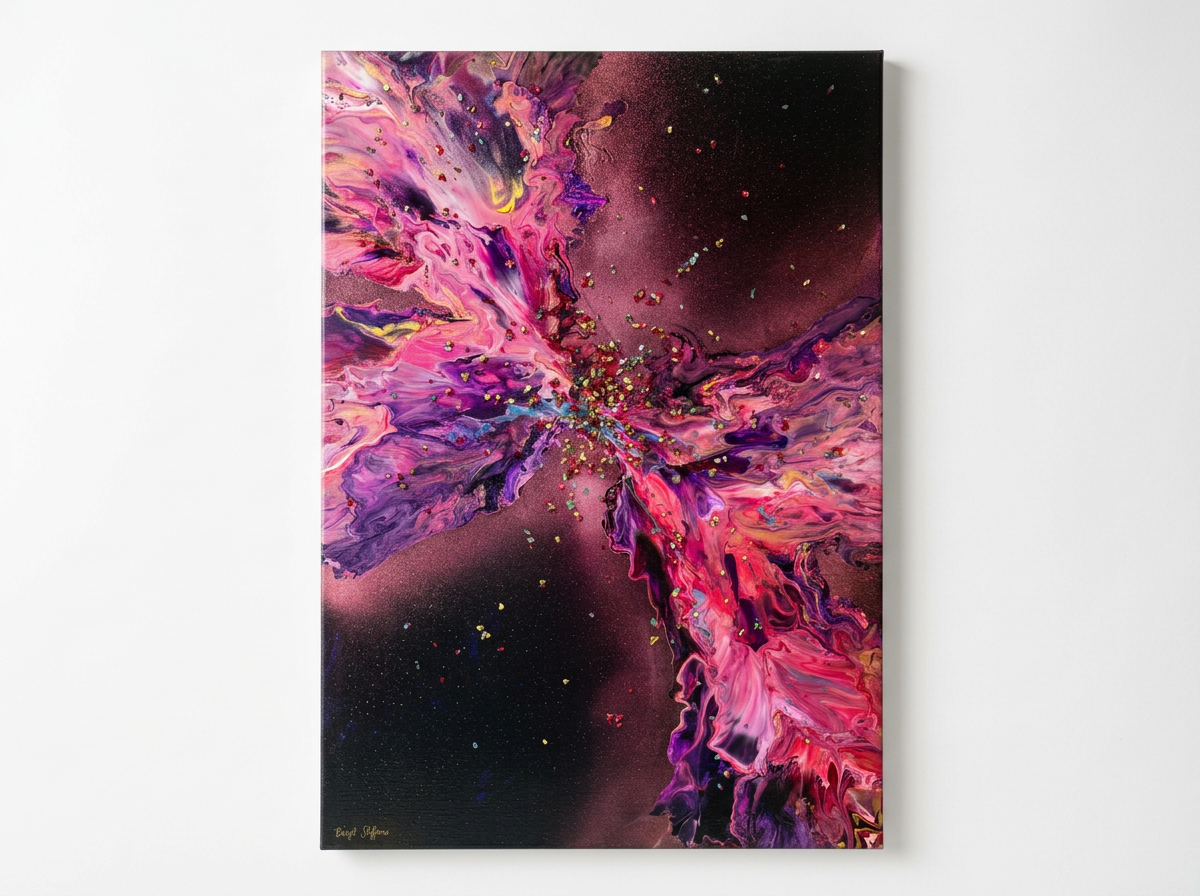
Birgit Steffens, The Last Day of Life of the Pink Planet, 24×36 in., acrylic, spray paint, rocks and glass fragments on canvas.
Most of my work begins with nature – not as a subject to depict in a realistic fashion, but as an abstract representation where pigments move the way water, wind and erosion move: unpredictably, according to their own logic, not mine.
I am endlessly fascinated by the chemistry of it – how different paints, brands and mediums make the colors resist or embrace each other, how a single tilt of the canvas or the substitution of one medium for another can send color spiraling into an entirely different result. The vast array of techniques and tools available for fluid pouring further multiplies the possibilities for the colors to interact with each other and create new, beautiful outcomes.
What keeps me returning to this process is its range. The same fundamental act — letting fluid pigment move — can produce an explosive burst of energy or the soft, gentle sway of water plants in a slow-moving, gurgling creek. It can settle into the hush of an empty arctic landscape or erupt into the chaos of a planet scattering into a thousand fragments. I never fully know what the paint decides to do until it settles, whether it will be a calm, serene rendition or an energetic or even violent one. Once the paint has found its place, it is my job to recognize the design the paint has chosen and to decide how to potentially enhance it with the help of other media, let it be with spray paint, rock, fire glass, sea shells, moss and other plants, through gilding or by applying different sheens of varnish in different area as some examples.
This painting started out as acrylic pour in mostly pink and red colors. Once the paint had settled, the energy and chaos bursting out from the center became evident. Spray paint on the negative space, representing the universe with all its stars and galaxies made the burst of color pop out even more, and it became clear that this was the picture of a massive explosion that cried for fragments of the destroyed planet scattering away from the center, a perfect example how the painting lets itself known during its creation.
Birgit Steffens, The Last Day of Life of the Pink Planet, 24×36 in., acrylic, spray paint, rocks and glass fragments on canvas.
Most of my work begins with nature – not as a subject to depict in a realistic fashion, but as an abstract representation where pigments move the way water, wind and erosion move: unpredictably, according to their own logic, not mine.
I am endlessly fascinated by the chemistry of it – how different paints, brands and mediums make the colors resist or embrace each other, how a single tilt of the canvas or the substitution of one medium for another can send color spiraling into an entirely different result. The vast array of techniques and tools available for fluid pouring further multiplies the possibilities for the colors to interact with each other and create new, beautiful outcomes.
What keeps me returning to this process is its range. The same fundamental act — letting fluid pigment move — can produce an explosive burst of energy or the soft, gentle sway of water plants in a slow-moving, gurgling creek. It can settle into the hush of an empty arctic landscape or erupt into the chaos of a planet scattering into a thousand fragments. I never fully know what the paint decides to do until it settles, whether it will be a calm, serene rendition or an energetic or even violent one. Once the paint has found its place, it is my job to recognize the design the paint has chosen and to decide how to potentially enhance it with the help of other media, let it be with spray paint, rock, fire glass, sea shells, moss and other plants, through gilding or by applying different sheens of varnish in different area as some examples.
This painting started out as acrylic pour in mostly pink and red colors. Once the paint had settled, the energy and chaos bursting out from the center became evident. Spray paint on the negative space, representing the universe with all its stars and galaxies made the burst of color pop out even more, and it became clear that this was the picture of a massive explosion that cried for fragments of the destroyed planet scattering away from the center, a perfect example how the painting lets itself known during its creation.